Choosing a reliable Varsity Jacket manufacturer in China requires more than comparing polished websites. Factory experience, material quality, communication, and production control can vary widely between suppliers. This guide examines ten notable manufacturers through practical sourcing factors, including customization ability, minimum order quantities, sample quality, lead times, and export experience.
A serious evaluation begins with the jacket itself. Check the wool blend, leather or faux-leather sleeves, ribbed cuffs, snap buttons, stitching, and embroidery detail. A weak collar may curl after washing. Loose threads can expose poor finishing. These small details matter.
The review also considers factory transparency. Reliable manufacturers should provide clear specifications, realistic timelines, and consistent quotations. Certifications, quality-control procedures, and documented production capabilities can strengthen buyer confidence. However, online claims should not be accepted without verification. No ranking is flawless. Supplier performance may change with staff, equipment, order volume, or seasonal demand.
Requesting a physical sample remains essential. It allows buyers to inspect weight, fit, color accuracy, packaging, and logo placement before placing a larger order. Communication tests are useful too. Ask how the supplier handles revisions, defects, replacement requests, and shipment delays. Their response often reveals more than a sales brochure.
The manufacturers discussed here are compared for different business needs, including school teams, fashion labels, retailers, and promotional programs. Some may excel at low-volume customization, while others may offer stronger factory capacity. Careful due diligence is still necessary. The right choice depends on product goals, budget, market standards, and expected order growth.
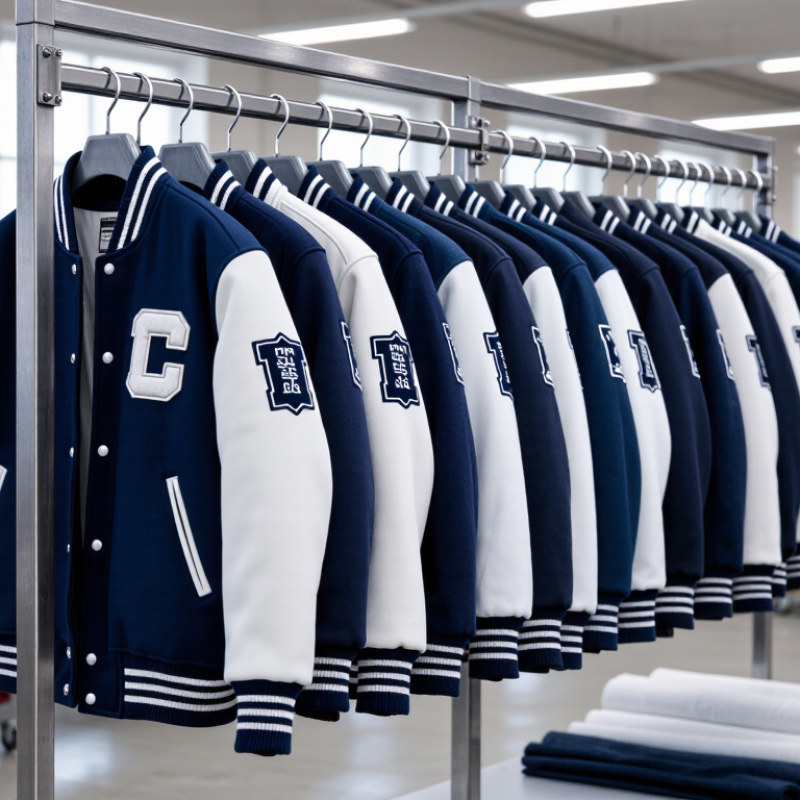
A leading Chinese varsity jacket manufacturer is defined by more than a polished catalog. It should show real production experience, from wool-blend body panels to leather sleeves and rib-knit cuffs. Factory visits, sample reviews, and repeat orders reveal more than marketing claims. Skilled teams check seam density, snap alignment, embroidery edges, and pocket strength before packing. Small details matter. A jacket can look impressive online yet feel stiff or uneven in hand. That gap deserves attention.
Professional manufacturers document fabric weights, color standards, shrinkage results, and tolerance ranges. They explain whether a patch is chenille, embroidery, or a heat-applied transfer. Clear technical sheets help buyers compare ten suppliers fairly. Reliable communication is equally important. A capable export team confirms measurements, carton dimensions, lead times, and inspection points in writing. It should also provide traceable production photos or inspection records while protecting confidential designs. Vague promises are not enough.
Responsible factories maintain orderly lines, trained operators, and consistent quality checks. Certifications can support credibility, but buyers should verify their scope and validity. Compliance paperwork alone does not guarantee a durable jacket. Ask for pre-production samples and test washing, rubbing, and zipper performance. Even experienced manufacturers make mistakes. Misplaced labels, slight color shifts, or delayed approvals can happen. The stronger supplier acknowledges these risks, proposes corrections, and keeps a clear record of every change.
What Are China Top 10 Varsity Jacket Manufacturers?
How the Top 10 Chinese Varsity Jacket Manufacturers Are Selected
The top ten should not be chosen by website appearance or low prices. A reliable ranking needs measurable evidence from factory audits, sample reviews, and export records. I would score quality control at 30%, production capacity at 20%, material sourcing at 15%, delivery reliability at 15%, and communication at 20%. This weighting may need adjustment for small custom orders.
The Textile Exchange 2024 Materials Market Report recorded global fiber production at 124 million tonnes in 2023. That figure shows why material traceability matters. Selected manufacturers should identify wool blends, recycled fibers, lining composition, and dyeing processes. They should also provide test reports for colorfastness, shrinkage, seam strength, and metal accessories. A serious review checks at least three production samples, not one perfect showroom piece.
Tips: Request a pre-production sample, a measurement chart, and a written defect policy. Ask for monthly capacity during peak seasons. Verify whether embroidery remains flat after washing. One overlooked detail is carton moisture protection. It can affect collars and leather sleeves during long transit. Factory rankings are never permanent. A supplier may improve quickly, while another may lose consistency after winning larger orders. That uncertainty deserves honest scoring.
Profiles of China’s Top 10 Varsity Jacket Manufacturers
China’s leading varsity jacket manufacturers differ in scale, specialization, and production discipline. This profile reviews ten supplier types often selected by overseas buyers after factory checks, sample reviews, and quality discussions.
The first specializes in heavyweight wool bodies and reinforced leather sleeves. The second focuses on lightweight jackets for school teams and seasonal collections. The third is experienced with chenille patches, embroidery, and appliqué details. Another operates compact production lines for smaller custom orders. One factory emphasizes recycled polyester and lower-impact packaging. A fifth supplier offers strong control over rib-knit collars, cuffs, and waistbands. One manufacturer is known for detailed size grading across Asian, European, and North American measurements. Another supports rapid sampling, although speed may affect stitching consistency. A larger facility manages bulk orders with cutting, sewing, decoration, and inspection under one roof. The final profile represents a flexible workshop serving independent labels and student organizations.
Practical experience shows that attractive samples do not guarantee stable mass production. Buyers should inspect seam density, snap strength, fabric weight, colorfastness, and patch alignment. Factory audits, material records, and pre-shipment inspections add useful evidence. Certifications can help, but they require verification rather than blind trust. Some suppliers communicate clearly during sampling, then become slower during production. That weakness matters. A dependable manufacturer explains limitations early, confirms measurement charts, and records approved details. Even strong factories may miss a thread or misread a color code, so careful review remains necessary.
Industry benchmark timeline for evaluating custom varsity jacket suppliers in China
The chart presents typical apparel-sourcing lead-time ranges rather than company-specific results. Actual timing depends on materials, order quantity, artwork complexity, sample approvals, and quality-control requirements.
Comparing China’s top ten varsity jacket manufacturers requires more than checking catalog photos. Material selection affects warmth, weight, and long-term appearance. Common options include wool blends, recycled polyester, cotton twill, synthetic leather, and genuine leather. Wool-blend bodies feel substantial, while polyester offers easier care and steadier costs. Rib-knit cuffs should recover after stretching. Weak ribbing quickly reveals poor production control.
Customization separates capable factories from simple trading offices. Ask whether the workshop can develop woven patches, chenille letters, embroidery, printed lining, and metal snaps in-house. Request a physical sample before approving bulk production. Check the collar shape, sleeve attachment, pocket reinforcement, and size grading. Small errors become expensive at scale. I have seen attractive samples hide uneven stitching and incorrect color matching.
Production capability also depends on order flexibility, equipment, and inspection discipline. A reliable manufacturer should explain fabric sourcing, cutting methods, sewing lines, pressing, packing, and final inspection. Confirm daily capacity, minimum order quantities, lead times, and replacement procedures. Independent material tests can verify colorfastness, shrinkage, seam strength, and fiber content. Factory photos help, but they are not proof. An on-site audit or live video inspection offers stronger evidence. Communication may still fail across languages and time zones. Build approval checkpoints into the schedule, especially for custom measurements and detailed artwork.
Choosing among China’s top 10 varsity jacket manufacturers requires more than comparing factory prices. Start with product evidence. Request a physical sample, not only digital mock-ups. Check the wool blend, leather or synthetic sleeves, rib tension, snap strength, and embroidery edges. Measure the jacket after washing. A two-centimeter shrinkage can change the fit noticeably.
Textile Exchange’s 2024 Materials Market Report recorded about 124 million tonnes of global fiber production in 2023. Polyester accounted for approximately 57 percent. Ask manufacturers for fiber composition records and recycled-content certificates. Supplier experience matters, but documentation matters more. Review factory audits, production capacity, export history, and quality procedures. ISO 2859-1 sampling can support an acceptable quality limit inspection, though it cannot replace personal testing.
Ask for a clear quotation covering fabric weight, trims, packaging, tooling, and shipping terms. Confirm the minimum order quantity and sample lead time in writing. A lower unit price may hide expensive revisions. Request close-up photos of seam density and inside finishing. Also inspect how the factory handles size grading. Small errors become costly across several thousand jackets. The International Trade Centre’s trade data can help compare China’s apparel export performance and destination markets. Still, trade volume does not prove workmanship. I would keep one concern visible: a polished showroom sample may not represent bulk production. Place a controlled trial order and inspect it before scaling.
| No. | Evaluation Dimension | Practical Industry Benchmark | How to Verify | Importance | Suggested Score |
|---|---|---|---|---|---|
| 1 | Manufacturing Experience | At least 5 years of documented experience in cut-and-sew outerwear or varsity jackets. | Review factory records, export history, production photos, and recent customer references. | High | 15% |
| 2 | Material Availability | Access to wool-blend melton, cotton, polyester, PU leather, rib-knit, satin, and recycled fabrics. | Request fabric swatches, fiber composition, GSM data, and colorfastness information. | High | 12% |
| 3 | Customization Capability | Capability to handle custom patterns, color combinations, embroidery, chenille patches, printing, labels, and hardware. | Ask for a tech pack review and examples of comparable custom constructions. | High | 15% |
| 4 | Minimum Order Quantity | Sampling commonly starts at 1–3 pieces; bulk MOQs often range from 50–300 pieces per style, depending on materials and customization. | Obtain a written MOQ schedule for samples, colors, sizes, and repeat orders. | High | 10% |
| 5 | Sample Development | A first prototype is commonly completed within about 7–15 working days after receiving complete specifications. | Confirm sample fees, revision policy, measurement tolerances, and approval procedures. | High | 10% |
| 6 | Quality-Control System | Documented inspection from incoming materials through sewing, decoration, measurement, finishing, and final packing. | Request inspection checklists, defect standards, measurement reports, and pre-shipment photos. | Very High | 15% |
| 7 | Compliance and Testing | Ability to provide relevant material declarations and testing for destination-market requirements, such as restricted substances and labeling. | Check valid laboratory reports, fiber labels, care labels, packaging marks, and applicable compliance documents. | Very High | 12% |
| 8 | Production Capacity | A suitable partner should disclose realistic monthly capacity, peak-season limitations, and line allocation for custom orders. | Compare capacity statements with factory size, workforce, equipment, and previous delivery records. | Medium to High | 7% |
| 9 | Lead Time and Delivery Control | Bulk production often requires approximately 25–45 working days after sample approval, material confirmation, and deposit. | Request a milestone schedule covering material sourcing, cutting, sewing, decoration, inspection, and shipment. | High | 8% |
| 10 | Communication and Commercial Terms | Clear English communication, transparent quotations, secure payment terms, export documentation, and responsive after-sales support. | Use a written quotation and evaluate response time, cost breakdown, contract terms, and dispute handling. | High | 6% |
Selection note: The benchmarks above are general purchasing references for comparing Chinese varsity jacket manufacturers. Actual MOQ, pricing, lead time, testing requirements, and production capacity should be confirmed in writing for each specific project.
Look beyond polished catalogs. Check production experience, sample quality, factory organization, and repeat orders. Inspect seams, snaps, embroidery edges, cuffs, and pockets. Clear records matter too.
Digital images hide stiffness, uneven seams, and inaccurate colors. Feel the fabric directly. Measure the jacket before and after washing. Even two centimeters of shrinkage can affect fit.
Check wool weight, sleeve material, rib tension, snap strength, and patch alignment. Examine inside finishing carefully. Weak pockets and loose threads reveal rushed production.
Request fiber composition, fabric weight, color standards, shrinkage results, and tolerance ranges. Ask for measurement charts and inspection records. Vague promises are not enough.
Use the same technical sheet for every quotation. Compare fabric, trims, packaging, tooling, shipping, minimum orders, and sample timing. A cheaper price may hide revision costs.
No. Certifications can support credibility, but buyers must verify their scope and validity. Test washing, rubbing, zippers, and colorfastness yourself. Paperwork cannot replace inspection.
Color shifts, misplaced labels, inconsistent stitching, and delayed approvals may happen. Mistakes still happen. A dependable factory records changes and proposes corrections quickly.
Start with a controlled trial order. Inspect its seam density, sizing, snaps, patches, and packaging. Bulk production should follow evidence, not enthusiasm. I would keep that concern visible.
This article explores what defines a leading Chinese Varsity Jacket manufacturer, focusing on craftsmanship, material quality, production consistency, communication, and the ability to meet international customer requirements. It explains how the top 10 manufacturers are selected through factors such as manufacturing experience, customization services, product quality, production capacity, delivery reliability, and customer support. Each manufacturer profile highlights different strengths without relying on brand names, helping readers understand the variety of suppliers available in China.
The comparison also examines fabric choices, leather or synthetic sleeves, lining materials, embroidery, patches, printing, color options, sizing, sample development, and bulk-order capabilities. Finally, the article offers practical guidance for choosing the right supplier based on design complexity, order quantity, budget, quality standards, lead time, and communication needs. By considering these factors together, buyers can make a more informed decision and select a Varsity Jacket manufacturer that matches their project goals and long-term production expectations.

Zhongda Wincome