2026 Top Kids Puffer Jacket Manufacturers for Global Buyers

Time:2026-11-11 Author:Sophia
0%

Choosing a Kids Puffer Jacket manufacturer involves more than comparing prices. Buyers need to assess warmth, weight, stitching, sizing, and supply reliability. Textile Exchange’s Materials Market Report 2024 estimated that global fiber production reached 124 million tonnes in 2023, with polyester accounting for 57%. This scale helps explain why synthetic shell fabrics are common in padded outerwear. It does not prove that every material or factory meets a buyer’s requirements.

For global buyers, useful checks include fabric specifications, insulation details, sample quality, minimum order quantities, and production lead times. Ask how suppliers verify color consistency and inspect seams around high-stress areas, such as pockets and cuffs. Request evidence behind claims about recycled fibers or insulation content. A product photo is not enough. Textile Exchange’s figures describe the fiber industry, not children’s jacket sales or factory performance. That distinction matters.

This guide to 2026 manufacturers can help buyers compare suppliers using practical questions rather than rankings alone. Look for clear communication, repeatable quality checks, and documentation that matches the finished garment. Confirm size ranges and test samples against the intended market and use. Small details count. A zipper that catches, or a cuff that lets in cold air, can undermine an otherwise promising jacket. Supplier claims still need checking, and no single factory will suit every buyer.
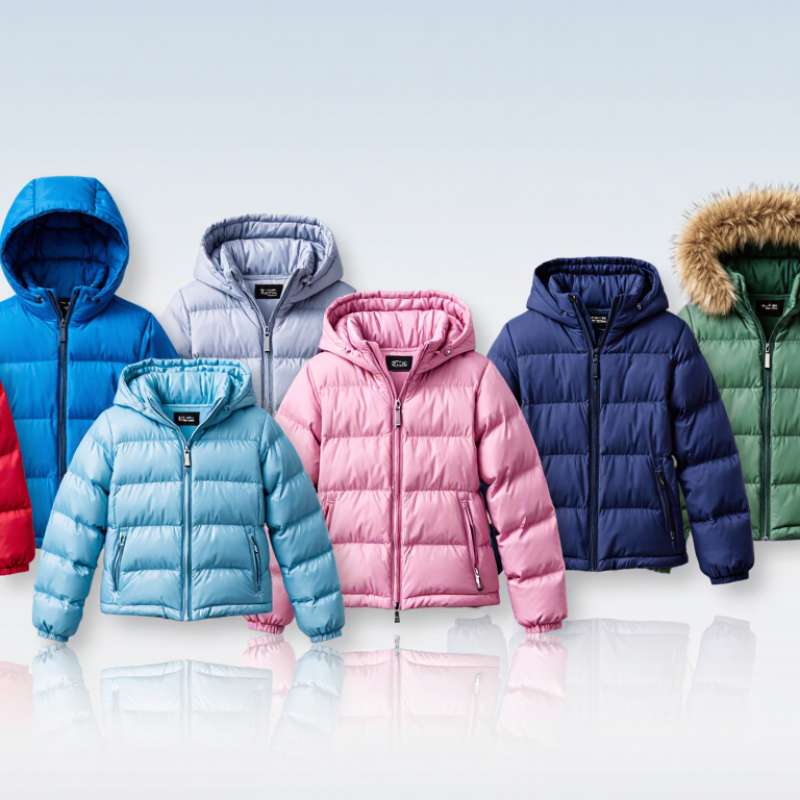
2026 Top Kids Puffer Jacket Manufacturers for Global Buyers

Kids' Puffer Jackets: Product Types and Global Market Overview

Kids’ puffer jackets range from lightweight quilted layers to hooded winter coats with synthetic or down insulation. Short styles suit active school days; longer cuts offer extra coverage in colder weather. Reversible designs add variety, while detachable hoods can make fit adjustment easier. Small details matter: zipper guards protect chins, elastic cuffs help block drafts, and roomy sleeves allow sweaters underneath. Check fill weight as well as warmth claims. They are not the same measure.

Global buyers often balance climate, price, care needs, and material preferences. Textile Exchange’s Materials Market Report 2024 estimates that global fiber production reached 124 million tonnes in 2023, with polyester accounting for 57 percent. That context helps explain why polyester shells and synthetic fills are common, though it does not show demand for children’s jackets specifically. Buyers should compare insulation, stitching, wash instructions, and fabric feel on actual samples. Cold-region orders may need longer coverage and stronger insulation; milder markets often favor lighter layers. A specification sheet helps. But it cannot replace wear testing: cuffs may stretch, and a jacket that looks warm on a hanger may feel bulky in motion.

Leading Kids' Puffer Jacket Manufacturers for Global Buyers

Leading kids’ puffer jacket manufacturers for global buyers need to balance warmth, comfort, and repeatable quality. A sample should feel light, with quilting that stays even when the jacket is folded and packed. Buyers can check seam strength, zipper movement, lining comfort, and how the cuffs fit over a sweater. Small details matter. A soft chin guard can prevent a zipper from rubbing a child’s skin.

Reliable suppliers explain their materials and production steps clearly. Ask for fabric, insulation, and trim specifications, plus test reports relevant to the intended market. Compare those records with the finished sample; a document alone does not prove that every production batch matches. Request size sets across the planned age range, since sleeve length and body volume can vary more than expected. That takes discipline.

Global orders also depend on clear timelines, realistic minimum quantities, and consistent communication when materials change. A factory may offer attractive pricing, yet slow replies or vague quality controls can create costly surprises. Review a pre-production sample and agree on inspection points before bulk manufacturing begins. Even then, small variations can occur. Buyers should leave room to improve fit and insulation choices after wear testing, rather than treating the first sample as perfect.

How to Assess Materials, Design, and Production Capabilities

A dependable kids’ puffer jacket begins with materials that suit its intended use. Ask for shell and lining fabric details, insulation type, and care instructions. Feel the sample: does the shell resist light abrasion, and does the lining slide smoothly over a sweater? Check that the fill stays evenly distributed after gentle handling. Small details matter. Inspect seams, zipper ends, and pocket edges for loose threads or rough spots. Request wash-test results and compare the jacket before and after laundering; a neat showroom sample alone proves little.

Design should allow children to move, layer, and dress themselves. Check sleeve reach, hood fit, and whether the zipper is easy to grip with small hands. Avoid loose drawcords around the neck. Ask how size grading is reviewed across the range, not just on one sample. Production capability needs the same close attention. Request a sample timeline, monthly capacity, inspection steps, and a clear plan for correcting defects. If possible, review a production-line sample and inspect random pieces from a finished batch. A factory’s answers may sound polished, so ask for records. I would still leave room for uncertainty: one successful sample cannot guarantee every shipment.

Safety, Quality, and Compliance Requirements for Children's Jackets

For children’s puffer jackets, safety starts with details that are easy to overlook. Check hood and neck areas for hazardous cords, and make sure zipper pulls and decorative parts cannot detach easily. Small components need careful review. Test closures and seams on finished samples, not just fabric swatches. A smooth zipper guard also helps protect a child’s chin.

Quality depends on more than warmth. Ask manufacturers to document insulation type, shell composition, and care instructions, then compare these details with the approved sample. Check whether quilting stays even and filling remains distributed after washing. A cold-room or wear trial can reveal drafts around cuffs and hems. Results may vary between sizes, so inspect more than one.

Compliance requirements differ by destination and product design. Buyers should identify applicable chemical, flammability, labeling, and mechanical-safety rules before production, then confirm test methods with a qualified laboratory. Keep reports linked to the exact materials and jacket version being shipped. Recheck when fabric, dye, trims, or suppliers change. Paperwork helps, but it can miss a flaw. That is why in-line inspections and clear defect limits matter. A little extra scrutiny may slow approval, yet children’s comfort and safety deserve it.

Comparing Suppliers by Pricing, Minimum Orders, Lead Times, and Service

2026 Top Kids Puffer Jacket Manufacturers for Global Buyers

Comparing suppliers means looking beyond the unit price. Ask for separate costs for fabric, insulation, trims, sampling, and packaging. A low quote can change once these details appear. Check minimum order quantities by color and size, too. A supplier may accept 500 jackets overall but require 100 per color. That can leave small buyers with awkward size or color splits. Request a written quotation with the same specifications from each supplier.

Lead times need equally careful review. Ask how many days sampling takes, when bulk production starts, and what could delay shipment. Confirm whether the stated schedule includes fabric sourcing and inspection. Review a physical sample for stitching, zipper movement, pocket placement, and insulation distribution. Small issues show up clearly on a child-sized jacket. Ask how the supplier handles defects, replacement samples, and progress updates. A polished presentation is useful, but it cannot replace clear answers.

Tips: Send one detailed tech pack, including measurements, fabric weight, filling details, and color references. Ask for dated production milestones. Leave room for delays; I sometimes underestimate how long sample revisions take. Compare service quality through response clarity, not just speed.

2026 Top Kids Puffer Jacket Manufacturers for Global Buyers - Comparing Suppliers by Pricing, Minimum Orders, Lead Times, and Service

Planning benchmarks, not verified supplier quotations: The anonymous profiles below represent common supplier types, not named or ranked manufacturers. Indicative ranges vary by country, order quantity, fabric, insulation, testing requirements, and season. Price estimates assume a basic children’s padded jacket, bulk production, and FOB terms; request current quotations before purchasing.

Anonymous Supplier Profile Indicative FOB Price per Jacket (USD) Typical Minimum Order Bulk Production Lead Time Sampling & Development Typical Service Strengths Points to Verify
Large-Scale Integrated Factory $10–$22 500–1,500 units per style or color 45–75 days after approval of samples, materials, and order details Approximately 7–20 days; sample fees and courier costs may apply Higher-volume production capacity, coordinated material sourcing, and established quality-control processes Capacity allocation during peak season, testing scope, payment terms, and whether the quoted price includes trims and packaging
Mid-Sized OEM/ODM Factory $12–$28 300–800 units per style; color minimums may apply 50–80 days after specifications and pre-production sample approval Approximately 10–25 days; custom fabrics or trims can extend development Custom design support, flexible product specifications, and moderate order-size flexibility In-house versus subcontracted processes, production capacity, inspection standards, and ownership of patterns or artwork
Low-MOQ Specialist Factory $15–$35 100–300 units per style or color, subject to fabric availability 45–75 days; small orders are not necessarily faster Approximately 10–25 days; small-batch sampling may cost more per unit Smaller trial runs, closer communication, and potential support for emerging or seasonal collections Per-unit cost, fabric stock limitations, size-run requirements, and repeat-order consistency
Technical Outerwear Specialist $18–$45 300–1,000 units per style, depending on fabric and construction 60–90 days when specialized materials or performance testing are required Approximately 15–30 days, especially for testing or construction revisions Experience with functional details such as water-resistant shells, durable closures, and insulation options Test methods and results, performance claims, seam construction, material traceability, and children’s product compliance for the destination market
Trading Company with Partner Factories $13–$32 300–1,000 units per style; depends on the production partner 55–90 days, including order coordination and factory scheduling Approximately 10–25 days; development timing depends on the assigned factory Supplier coordination, sourcing assistance, export documentation support, and access to multiple production options Factory identity and audit access, service fees, responsibility for quality issues, and who controls production schedules

FAQS

What types of kids’ puffer jackets are available?

Options include lightweight quilted layers, hooded winter coats, reversible styles, and longer cuts. Short jackets suit active school days; longer ones cover more of the body.

How should buyers compare warmth?

Check insulation type and fill weight, not warmth claims alone. They measure different things. A jacket can look warm on a hanger but feel bulky in motion.

Which materials are common in these jackets?

Polyester shells and synthetic fills are common. Global fiber production reached 124 million tonnes in 2023, with polyester making up 57 percent. This figure does not measure children’s jacket demand.

What should buyers inspect on a sample?

Check shell feel, lining, seams, zipper ends, pocket edges, and fill distribution. Ask for wash-test results and compare the jacket before and after laundering. Samples can mislead.

How can a jacket support children’s movement?

Check sleeve reach, hood fit, and roomy sleeves for sweaters. Zippers should be easy for small hands to grip. Avoid loose drawcords around the neck.

Which safety details deserve close attention?

Inspect hood and neck areas for cords, and test whether zipper pulls or decorations detach easily. A smooth zipper guard can protect the chin. Small parts matter.

What production checks should buyers request?

Ask about sample timelines, monthly capacity, inspection steps, and defect correction plans. Review a production-line sample and inspect random pieces from finished batches. One approved sample proves little.

What quality and compliance checks are useful?

Compare insulation, shell composition, and care instructions with the approved sample. Identify requirements for the destination and confirm testing with a qualified laboratory. Recheck after material or trim changes; paperwork can miss flaws.

Conclusion

This guide explores the main types of kids’ puffer jackets and the factors shaping their appeal to buyers in different markets. It explains how warmth, insulation, weight, weather resistance, fit, and age-appropriate design influence product selection. Buyers will also find practical ways to assess a manufacturer’s materials, design support, production capacity, and ability to maintain consistent quality across orders.

The article also highlights safety and quality considerations for children’s outerwear, including suitable materials, secure construction, and clear product specifications. It compares suppliers through key purchasing factors such as pricing, minimum order quantities, lead times, communication, and after-sales service. By weighing these points together, global buyers can make more informed decisions when sourcing a Kids Puffer Jacket that suits their target customers, seasonal needs, and business requirements.

Sophia

Sophia

Sophia is a dedicated marketing professional with an exceptional depth of knowledge about her company's products and services. With a keen understanding of market trends and customer needs, she crafts insightful blog posts that not only inform but also engage readers, enriching the company’s online......